Sunday, April 30, 2017

Climate Change Protest March

http://www.philly.com/philly/health/cancer/Promising-therapy-for-rare-eye-cancer-raises-hopes-for-targeting-other-cancers.html This is an article from the Philadelphia Inquirer about a novel, light-activated drug for melanoma that affects the eyes. The drug is coupled with a light sensitive dye that is activated by laser light.

hs1eyecancer30-b-24042017-0005

https://www.nytimes.com/2017/04/29/world/europe/leeches-russia-medicine.html An article from the NYT about the uses of leeches in medicine. In the US, the FDA has licensed the use of leecges to remove excess blood from severed body parts that have been re-attached. In Russia they are used as a preventative for stroke and heart disease. Leech venom is a natural anticoagulant.


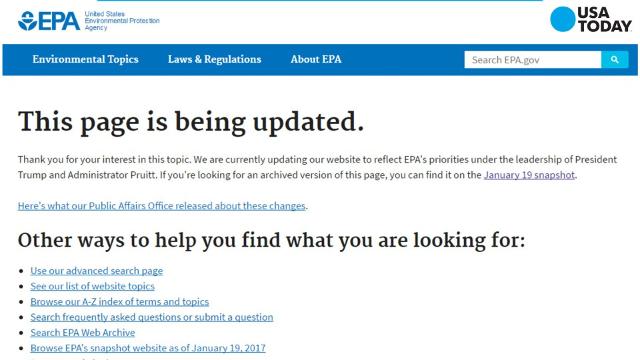
https://www.usatoday.com/story/news/politics/2017/04/29/epa-removes-climate-change-data-other-scientific-information-website/101072040/  From USA today a report that the EPA is removing its climate change data from its website with a view towards "reflecting the views of the leadership of the agency."


http://www.philly.com/philly/health/health-news/Five-Questions-about-blue-light-smartphones-ipads-iphones-sleep-optometric.html This is an article from the Inquirer about eye problems associated with excessive exposure to light in the blue range from computers and other devices. Concerns are about the propensity of excessive exposure to blue light causing eye strain, blurred vision, dry eyes. A survey by the American Optometric Association reveals that although 88% of Americans are aware of the fact that their vision can be harmed by the overuse use of these devices, they keep using them. To quote from the article, "The AOA has several recommendations.  First of all, the association urges patients to follow the 20-20-20 rule.  When you’re looking at a screen, take a 20-second break and look at something at least 20 feet away every 20 minutes."
iStock_laptop-3x2


https://www.nytimes.com/2017/05/03/sports/want-to-make-more-baskets-science-has-the-answer.html?_r=0 This is an article from the NYT about throwing more accurately. A paper published in Royal Society Open Science discusses the trade-off between throwing fast and throwing accurately and concludes that  throwing fast makes it harder to release the object at just the right moment. But, the study additionally concludes that the ball release speed affects the curvature of the path that the ball takes. The conclusions were based on mathematical modeling.


 https://www.nytimes.com/2017/04/24/well/family/fending-off-math-anxiety.html This is an opinion by Perry Klass about math anxiety in children. The doctor opines that, in order to instill number confidence in children it is important that early math skills be developed by parents talking to their children about numbers early in life much as  they introduce their children to letters and the alphabet as a preliminary to learning to read.  There is a program called "Bedtime Math" an app that presents short numerical problems to children. A 2015 study determined that children's math skilled improved if their parents used this program with them compared to a control group.


https://www.nytimes.com/2017/05/01/health/artificial-nose-scent-disease.html  From the NYT an article about a company called Owlstone, which manufactures chemical sensors. Although the company originated with the purpose of detecting chemical weapons and explosive, the focus has shifted to medical sensors, specifically cancer detection. They are currently conducting a trial with the University of Warwick, to detect colon cancer from urine samples.

https://www.nytimes.com/2017/05/07/us/politics/epa-dismisses-members-of-major-scientific-review-board.html?_r=0 An article from the NYT about the dismissal of at least 5 members of a major scientific review board which advised the EPA. Scott Pruitt intends for the EPA to become much more lenient towards the coal industry, contradicting the recommendations of both of the EPA;s scientific review boards. Both of the review boards have been the subjects of political attacks. A Republican senator from Texas says that the advisors will be replaced with members from "the business world."


https://www.scientificamerican.com/article/aspirin-may-prevent-cancer-from-spreading-new-research-shows/ This is an article in the SciAm about aspirin's actions in preventing malignancies. work done at Brigham and Women's Hospital has shown that platelets help malignant cells to spread and that cancer cells use platelets to hide from the immune system. Aspirin is able to "re-wire" megakaryocytes (progenitor cells of platelets) to turn of genes that allow platelets to camouflage cancer cells. This latter work was done at Duke University.


http://www.samefacts.com/2017/05/energy-the-environment/the-wall-street-cherry-picking-festival/ Here is a column called "The Wall Street Cherry-Picking Festival" about the second column by Bret Stephens, the "climate confusionist" hired by the NYT. The blogger criticizes the Times columnist for picking the only year in a data trend showing emissions in Germany that was an outlier, when emissions fell. The blog shows the comparable data chart for US, which show the same decrease for the year in question.


https://www.nytimes.com/2017/05/04/science/julius-youngner-dead-salk-polio-vaccine-researcher.html?_r=0 An obit in the NYT for Julius Youngner, co-inventor with Jonas Salk, of the polio vaccine. These early immunologists were really heroes.


hs1eyecancer30-b-24042017-0005

Sunday, April 23, 2017

March for Science

https://www.nytimes.com/2017/04/21/opinion/henrietta-lacks-why-science-needs-your-cells.html?_r=0  This is an opinion piece from the NYT written by a Harvard Law School and UPenn professor about the controversy around the Henrietta Lacks story. They make a solid point about how the injustice is in the racism in the medical treatment she received but the fact that her cells have been critical to many medical advances and treatments should not be decried as much as it has been and used as a teaching tool demonizing medical research. The opinion makes the point that no parts are being removed from peoples' bodies without their consent. Patients should be made aware  of how thier specimens are being used. This is an  important piece which can be studied in tandem with the HBO movie.


https://www.nytimes.com/2017/04/12/well/move/an-hour-of-running-may-add-seven-hours-to-your-life.html  This is a piece from the Well column in the NYT about how running can increase one's lifespan. The data comes from the Cooper Institute in Dallas.  The new study was published in Progress In Cardiovascular Disease.  Running, whatever the pace, dropped a person's risk of death by almost 40% and they determined that, if every nonrunner who had been part of the study took up the sport, there would have been 16% fewer deaths over all and 25% fewer fatal heart attacks.


https://www.nytimes.com/2017/04/17/science/march-for-science-voices.html  From the NYT about the holdouts. Some people "who work in a variety of scientific fields" according to the article, and are "passionate about science" will refuse to march in order to avoid what they see as the politicalization of science. In the responses sub,itted to the NYT, some Times readers feel that combining ideology and science would weaken the impact of basic research.


https://www.nytimes.com/2017/04/20/health/brain-memory-dementia-epilepsy-treatments.html This is an article from the NYT about the implantation of a pacemaker in the brain as a cure for epilepsy. The UPenn team did this study of epilepsy patients, which wa spublished in Current Biology. This is called "closed-loop cognitive stimulation" with implanted electrodes which deliver microsecond pulses.


https://www.nytimes.com/2017/04/21/opinion/the-planet-cant-stand-this-presidency.html An opinion piece by Bill McGibben, among others, about the possibilities for extinction of endangered organisms and other potentially dangerous effects on the environment with the rollback of environmental regulations and protections under the new Trump administration.


https://www.nytimes.com/2017/04/27/opinion/sowing-climate-doubt-among-schoolteachers.html?_r=0  This is an opinion from the NYT about the Heartland Institute's sending a book called "Why Scientists Disagree about Global Warming" to public school teachers in the US. The writer correctly calls this unscientific propaganda but warns that some teachers are vulnerable to this approach, especially those in states like Louisiana and Tennessee where state law allows teaching of alternative explanations of evolution and climate change. The implication is that this apprach may unfortunately mislead tens of thousands of students who teach from this book even if just a few teachers use it.


https://www.nytimes.com/2017/04/26/science/prehistoric-humans-north-america-california-nature-study.html This is an article in the NYT by Carl Zimmer about mastodon bones found near San Diego; the finding was published in the journal Nature.This is possible evidence that California's first settlers may have antedated the movement of humans out of Africa. They may have been Neanderthals or another extinct lineage.  The thought is that the smashed bones were broken by humans but some scientists speculate that the bone fractures may have been caused by factors other than human breakage.


https://www.nytimes.com/2017/04/26/nyregion/invisible-bird-killer-lurks-in-revitalized-new-jersey-meadowlands.html Also from the NYT a report about flames resulting from methane build-up in the Kingsland landfill in the NJ Meadowlands causing damage and death to birds and other wildlife. The landfill was closed in the 1990s but methane continues to build up from the garbage left behind.

Friday, April 7, 2017

Science for Life

http://www.sciencetimes.com/articles/11808/20170407/octopus-possess-super-power-rewrite-rna.htm
This is an article from Science Times which was taken from a Washington Post report about squid's and octopus' unusually ability to rewrite their own RNA. They can edit the RNA and make different proteins from the same RNA. The colder the habitat the more likely it is that the animal will make edits. Scientists want to use this to understand adaptability to the environment.


Sydneysiders Flock To Fishmarkets At Christmas Time

https://www.nytimes.com/2017/04/06/health/fda-genetic-tests-23andme.html?_r=0 This is an article from the Business Section of the NYT about the FDA permitting the genetic testing company 23andMe to sell tests predicting genetic risks of developing certain diseases directly to consumers. Customers who purchase a $199 kit can determine whether they have mutations that may predispose them to rare diseases such as Gaucher's Disease. Other diseases, like Parkinsons or Alzheimers are treated differently. An ethical question arises whether people need genetic counseling to deal with some of this information.


https://www.nytimes.com/2017/04/07/opinion/sunday/to-be-a-genius-think-like-a-94-year-old.html Article from the NYT about the most common ages for receiving patents, which is between 46 and 60. The point as articulated in a quote in the article is that "there is clear evidence" of the contributions of older people to invention.

https://www.nytimes.com/2017/04/08/fashion/sleep-tips-and-tools.html From the style section, no less, is an article about new research into the "ideal sleep environment".Researchers at UCLA Berkeley Sleep and Neuroimaging Laboratory are testing the effect of direct current stimulation on the aging brain to prevent sleeplessness. Hello, Inc. is the name of  a technology company started by a British entrepreneur which is developing products to improve sleeping for which Professor Matthew Walker of the Berkeley lab is the chief scientist. I had the pleasure of interviewing Prof. Walker for an article a couple of years ago.


https://www.nytimes.com/2017/04/10/health/ear-wax.html?_r=0 A snippet of an article in the NYT about cerumen, or ear wax.


https://www.nytimes.com/2017/04/10/climate/trump-nasa-satellites-global-warming-data.html An article in the Science Times about the possibility of a climate change data gap. "Climate monitoring  has fallen into a big gap" between NASA and NOAA because of the proposed cuts in the 2018 science budget according to Dr. Ackerman, a climate scientist at the U of Washington. Many of NASA's climate-monitoring instruments are at the end of their useful lives. Someone named Betsy Weatherhead, another climate scientist, is also interviewed.


http://www.pbs.org/newshour/updates/science-educators-stakes-teaching-next-generation-feel-higher-ever/ From PBS a news article about the NSTA conference in Texas and the motivation of science teachers in the era of science denial to teach young people as their legacy. Recently, a science-denial organization submitted anti-science and climate change denial materials into teachers' mailboxes.
Paul Reyna is in his 28th year teaching 6th grade science at Schrade Middle School in Rowlett, Texas. He has won numerous district teaching awards and was a Texas State Teacher of the Year finalist in 2007. Reyna shows a teacher a video of his students testing a rocket he invented, which . Educational Innovations now sells, at the National Science Teachers Assocation's conference in Los Angeles. Photo by Victoria Pasquantonio

https://www.insidehighered.com/news/2017/04/12/study-finds-female-professors-outperform-men-service-their-possible-professional This article from insidehighered.com reports a study published in Research in Higher Education done at UCRiverside and IU Bloomington with data from the national survey Faculty Survey of Student Engagement of 2014 and an annual faculty survey from two research-intensive universities, which concluded that women in the national sample performed 30 more minutes per week of service than men and 1.5 more service activities per year than men in the local sample.The study differentiated between internal and external service. The conclusion was that there was a "gender imbalance".


https://www.nytimes.com/2017/04/14/opinion/the-point-of-hate.html  This is a commentary in the NYT about why evolution has preserved hate. According to a 2008 study of the human brain there is a brain circuit of activated neurons to generate aggression. Some parts of the brain that are involved with hateful feelings overlap with parts of the brain involved in feelings of love. But the impulses for hateful feelings also responds to violations of cultural norms.and holds societies together., in effect, by punishing transgressors.


https://www.nytimes.com/2017/04/17/science/climate-change-glacier-yukon-river.html?_r=0 This is a link to an article in the NYT about the Kashawulsh Glacier, at which last spring melting waters cut through the ice, diverting water into the Alsek River, which flows on to the south and eventually into the Pacific.  Normally the water from the glacier flows north to the Bering Sea via the Slims and Yukon Rivers. The significance of this is the timing because it "normally" takes thousands of years to divert a river and this happened in a few months in 2016. Scientists call this "river piracy".

Tuesday, March 28, 2017

Not An April Fool

https://www.nytimes.com/2017/03/22/science/dinosaur-family-tree.html?_r=0 This is an article from the NYT about the reclassification of the dinosaur family tree. It used to be based on whether the dinosaurs were "bird-hipped" or "lizard-hipped", now that has changed. A graduate student has re-written the family tree of dinosaurs as a Ph.D. project. Since the Ornithischian dinosaurs didn't fit into the scheme he reconsidered the entire family tree visiting museums around the world. The results are to be published in the journal Nature.


https://www.nytimes.com/2017/03/27/opinion/the-trump-administrations-war-on-science.html This is an editorial from the Science Times inauspiciously titled "The Trump Administration's War on Science". "Setting free the dreams of the American people" seems to involve overturning worker protections, allowing big coal unfettered free reign, demolishing internet protections, returning foreign-born American citizens to their countries of origin if they are the wrong color and, according to this editorial shortchanging basic scientific research throughout the government. Forty of the top government science positions are currently vacant. The NIH is approving only 10-15% of eligible grant applications.


https://www.nytimes.com/2017/03/28/climate/trump-executive-order-climate-change.html?_r=0 This is an article in the NYT about Trump's signing the executive order rolling back Obama's climate change efforts. The Environmental Protection Agency is ordered to rewrite the Clean Power Plan to allow for the reopening, and construction of, new coal-fired power plants, leaving China as the main player in environmental efforts to curb pollution. There is also the sad possibility that Mr. Trump will renege on the Paris agreement. Whether this will lead to the promised greater number of mining jobs is pure speculation.


https://www.nytimes.com/2017/03/29/us/politics/epa-insecticide-chlorpyrifos.html?_r=0 This ia a NYT article about Scott Pruitt's refusal to ban chlorpyrifos from use as an insecticide. It has the potential to harm children and farm workers. The mechanism of chlorpyrifos is that it binds to acetylcholinesterase and keeps it from digesting unbound acethylcholine at the synapse, causing muscle paralysis and asphyxiation.


https://www.nytimes.com/2017/03/30/us/politics/science-technology-white-house-trump.html?_r=0 Article from NYT about the dearth of science advisors or occupied high level science positions including White House Chief Technology Officer in the new Trump administration. The deputy chief technology officer, who has a BA in political science, doesn't attend Trump's daily briefings, nor does anyone else in the science and technology office.

Thursday, March 16, 2017

Idling Through March

https://www.nytimes.com/2017/03/15/health/eyes-stem-cells-injections.html?_r=0 Starting this blogpost with a horrible report from the NYT about 3 patients who became blind after STEM cells derived from fat obtained from their liposuction were injected into their eyes in order to cure macular degeneration. This is a report from NEJM of three women who thought they were enrolling in government-approved clinical trials for a treatment for macular degeneration who each paid the company US Stem Cell for the treatments. Apparently the therapy was listed on a government website but didn't have government approval.


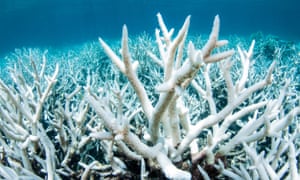
https://www.theguardian.com/environment/2017/mar/10/great-barrier-reef-coral-bleaching-worsens-as-scientists-fear-heatwaves-impact  The Great Barrier Reef has sustained significant damage due to coral bleaching, according to the Great Barrier Reef Marine Park Authority. High water temperatures are to blame. The worst-to-date mass bleaching event took place in 2016 and there is evidence that another mass bleaching event is taking place before the corals have had time to possibly recover.
A damaged coral reef

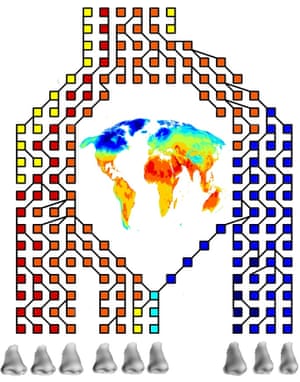
https://www.theguardian.com/science/2017/mar/16/climate-shaped-the-human-nose-researchers-say An article from the Guardian reporting how climate shaped the evolution of the human nose. The research was done at Penn State and published in PLOS Genetics. The study, based on variations of shapes of  human noses, confirmed that nose shape is "highly heritable" and found a link between nostril width and temperature. Nostrils function to warm the air.
Blue boxes represent alleles for narrower nares while red boxes represent alleles for wider nares. Colours in between represent intermediate phenotypes. The colour scale represents climatic variation in temperature and humidity, to show that narrower nares are favoured in cool-dry climates while wider nares are favoured in hot-humid climates.

https://www.nytimes.com/2017/03/12/business/lloyd-conover-dead-inventor-of-groundbreaking-antibiotic.html A NYT obit for Lloyd Conover, who discovered tetracycline. He also discovered that natural products could be modified synthetically to make them more effective. Taxol, a frontline cancer chemotherapy is made partly from the bark of a yew tree and partly by chemical synthesis.


http://hyperallergic.com/361446/picturing-math-at-the-metropolitan-museum-of-art/  This is from the blog Hyperallergic about a new exhibit at the Met on artistic expressions of math. Picturing Math has prints that go back seven centuries and also includes some modern and contemporary pieces.


https://www.nytimes.com/2017/03/16/world/canada/trump-budget-canada-great-lakes.html?_r=0 Article for NYT about the 2018 Trump budget which proposes to gut the Great Lakes Restoration Initiative which was tasked with water clean up and algae removal on both sides of the border. This is rightly perceived as an unwillingness to collaborate with our northern neighbor on environmental remedy.


http://bigthink.com/strange-maps/a-map-of-lexical-distances-between-europes-languages This is a link from the blog bigthink which shows the "lexical" distances between Europe's languages. The smaller the distance between languages, the more words are shared. Maybe this is obvious but I love information rendered in graphical format and all maps. The map also shows orphan languages (without families) like Albanian and Greek.


https://www.nytimes.com/2017/03/17/opinion/sunday/the-seasons-arent-what-they-used-to-be.html?_r=0  From the NYT Sunday Review section an opinion piece about the start of Spring  Monday (for us) and the disconnect for plants and animals. Spring peepers, for the writer, were unleashed in February in Tennessee for example. The spring emergence of leaves, amphibians, birds and insects is advancing 2.8 days per decade in the Northern Hemisphere. Did you know what phenology is? It's the study of the seasonal timing of biological events.


https://www.nytimes.com/2017/03/20/upshot/why-cystic-fibrosis-patients-in-canada-outlive-those-in-the-us.html?_r=0 Article from the NYT reporting a publication from the Annals of Internal Medicine that sufferers from cystic fibrosis have longer life spans in Canada than US although the life spans in both countries increased.  It should be noted that more CF sufferers in Canada received lung transplants although few in general received the transplants so there must be other factors involved.


https://www.nytimes.com/2017/03/17/health/global-health-fogarty-international-center-viruses.html?_r=0 This is an article from the NYT about the 2018 budget plan to eliminate the Fogarty Center, part of the NIH, which is a reference lab for the WHO and collects and shares information about disease outbreaks, with the idea of developing vaccines. These various reference labs are considered "sentinel labs" and only two are in American hands.


https://earth.nullschool.net/ This is a neat graphic showing wind, weather, ocean and pollution conditions as predicted by supercomputers. It's an interactive, animated map.

http://www.huffingtonpost.com/entry/critical-thinking-pseudoscience_us_58d14903e4b0be71dcf83b0e This is a link to a Huff Post article about a Humanities course at North Carolina State University investigating historical frauds. A study was done of students in the class which found that participation in the course had reduced students' belief in psuedoscience and developed their critical thinking skills.


https://www.forbes.com/sites/tarahaelle/2017/03/23/breaking-the-cold-chain-new-vaccine-doesnt-need-refrigeration/#38807e457912 From Forbes magazine a report of a rotavirus vaccine developed in India that doesn't need refrigeration. Rotavirus causes 1/3 of all cases of diarrhea and kills a lot of children. Doctors Without Borders, the Cincinnati Children's Hospital and the Serum Institute of India conducted the Phase III clinical trial. This disease affects people without access to electricity and water which is why this vaccine is important.

A infant in Mozambique receives an oral vaccine. Photo by Tara Haelle during a reporting fellowship from the International Reporting Project.

https://www.nytimes.com/2017/03/24/world/asia/china-air-pollution-smog-climate-change.html This is an article from the NYT about the effects of climate change in China. As reported in the journal Science Advances, the "airpocalypse" that fell on Beijing in January of 2013 was due to unusually stagnant air brought on by climate change.


https://www.nytimes.com/2017/03/24/opinion/the-real-threat-to-national-security-deadly-disease.html An editorial in the NYT about the importance of infectious diseases to national security. The editorial writers fume about the cuts in the State Department, NIH (18%) and United States Agency for International Development (28%) budgets and the increase in military spending. The spread of antibiotic resistant bacteria is also mentioned as a global threat. There is as yet no licensed vaccine for Ebola or plan to deal with an epidemic.

Tuesday, February 28, 2017

February and 70 degrees

https://www.nytimes.com/2017/02/28/technology/science-research-researchgate-gates-goldman.html?_r=0
This ia an article in the business NYT about ResearchGate, which is a science "social medium" in which scientists and researchers can have "followers" like on FB or Twitter, etc. ResearchGate is actually a company backed by venture capital investors that allows scientists to update followers on their research and share data. This is an example of a trend that aims to make science more transparent.


https://www.nytimes.com/2017/02/27/health/who-bacteria-pathogens-antibiotic-resistant-superbugs.html
Another article from NYT about a WHO report about drug-resistant superbugs. Several new antibiotic resistant bacteria have been identified that potentially could prove as dangerous to human health as Zika or Ebola. It is estimated that they cause 23,000 deaths per year in America alone. A recommendation was made to deal with the worst of the superbugs first and not just rely on "market forces alone". "Market forces" seems like a curious formulation but I guess that is a way of declaring that research priorities ought to be reorganized.


http://www.sciencemag.org/news/2016/03/how-sliced-meat-drove-human-evolution Article from Science magazine about how sliced meat drove human evolution. Although it sounds humorous and makes one think of glistening packages at ShopRite, this has more to do with the early members of genus Homo evolving smaller teeth as a result of the development of small stone flakes to cut the elastic muscles of carcasses into chewable pieces.
Simple stone tools may have allowed early <i>Homo</i> to start eating meat and root vegetables, even before cooking became common.

https://www.nytimes.com/2017/03/01/science/earths-oldest-bacteria-fossils.html?_r=0 This is a NYT article by Carl Zimmer about bacterial fossil findings in Canada. These were found on the remote coast of Hudson Bay and may be the oldest fossils ever discovered. A geologist at the University of New South Wales called them "dubiofossils" with doubts that they had ever been part of a living organism.


https://www.nytimes.com/2016/04/14/world/asia/inky-octopus-new-zealand-aquarium.html?_r=0 An article from the NYT about an octopus in New Zealand escaping from the aquarium by slipping through a hole in the top of its tank, sliding across the floor and going down a drainpipe into the ocean.


https://www.msn.com/en-us/money/companies/drug-companies-block-shareholders-voting-on-price-transparency/ar-AAnHidX From the WSJ reported by MSN an article about drug companies blocking shareholders' votes on price transparency.  Pfizer and Merck were asked to submit annual average price increases for their top-selling drugs and ten were going to omit this proposal from their proxy ballots.The SEC furthermore is not going to enforce it if the companies exclude the proposals.

http://www.philly.com/philly/health/Philly-gene-therapy-hemophilia-spark-pfizer.html This is an article from the Philadelphia Inquirer detailing the development of a "one- shot" treatment for the inherited blood disorder Hemophilia. Spark Therapeutics, an offshoot from Children's Hospital of Philadelphia has developed a gene therapy made originally from the DNA of a "superclotter" which cures the disease.


http://www.smithsonianmag.com/smart-news/caesarean-births-could-be-affecting-evolution-180961316/  This is an article from the Smithsonian magazine about the effects on evolution of the increase in Caesarean births. 1/3 of births in the US are through C-sections.The number of babies too large to be delivered vaginally have gone up 20% since C-sections began. It's possible that this is allowing genes for bigger babies to be passed down which formerly would have been deadly.
baby