Tuesday, January 2, 2018

Happy New Year- Entering Third Year of SoSo (Solipsist's Soiree)


https://www.nytimes.com/2018/01/02/upshot/us-health-care-expensive-country-comparison.html Article from the NYT business section about the percentage of the country's economy spent on health care- 17.9% of the GNP, twice as much as other industrialized countries. A Princeton University health economy study concluded that people in the US use the same amount of health care as in other wealthy countries, but may a lot more for it. In a recent study in JAMA  researchers looked at the breakdown for 155 different health conditions and found that American personal heath spending grew by $930 billion between 1996 and 2013 (adjusted for inflation). They also found that this didn't have primarily to do with the increase in population size and the aging of the population. After accounting for these demographic factors, spending grew by about $574 billion during those years. The conclusion from this study is that more is done for patients during hospital stays and doctor visits and that patients are charged more for these services. The author conlcudes that an all-payer system (like Maryland) or a single payer system is the solution.


https://www.nytimes.com/2018/01/01/business/energy-environment/climate-change-enzymes-laundry.html  In this NYT artles, "Rooting in the Rot for Clean Ideas", the author mentions a Danish biotech company is trying to discover a more environmentally friendly detergent and is testing oyster mushrooms, which contain enzymes that speed up chemical reactions or natural processes like decay.
Enzymes are also well-suited to cut energy consumption, and because they are found in cool environments like forests and oceans, they don't require the heat and pressure used by washing machines. In face, lowering the temperature on a washing machine to cold water reduces energy consumption by at least half. New enzymes are also attractive to consumers in fast-growing economies like China.


https://www.nytimes.com/2017/12/29/climate/google-search-climate-change.html Another article from NYT about how Google's algorithms many times display climate change deniers' results at the top of searches. The fact that the denialists' ads pop up with such frequency and prominence, shows that the climate change deniers are able to "game the system". But Google also claims that many ads are removed and violators punished for policy violations. Google doesn't want users to be misled by their ads or information, according their published policies. But somehow by the practice of allowing bidding for terms, DefyCCC wound up owning the climate change term.


https://www.nytimes.com/2018/01/06/opinion/sunday/diabetes-shouldnt-bankrupt-you.html?_r=0 An article from the NYT about the costs of chronic disease. People with long term or chronic medical conditions often owe their lives to medical innovations that allow them to continue living long and productive lives but also live those lives in fear of financial ruin, bancruptcy or the inability to get good coverage. Dialysis patients are actually an exception due to a 1972 act of Congress allowing people with end-stage kidney failure who are on dialysis to get automatic Medicare coverage. This same coverage should be provided to other chronic disease sufferers, such as the coverage provided for German citizens who can pick a "sickness fund" to contribute to, with a 15% of their income contribution from the individual's income, half from their employer and half from their paychecks. This is based on the principle of "solidarity", not "individuality".


https://www.nytimes.com/2018/01/04/opinion/trump-disdain-science.html  This is from the NYT OP-ED page written by a former science advisor to President Clinton and a physics professor at UC Santa Cruz about the fact that after a year in office President Trump hasn't named a science advisor and director of the White House Office of Science and Technology Policy. The job of this individual would be to pull up the necessary information for the president and cut through any conflicting advise from senior secretaries and other cabinet officials.  The writers make the point that, absent a science advisor, the president and his administration have still made decisions on health and environmental policy and national security issues involving science that amount to assaults on existing laws, including the decision to pull the nation out of the Paris climate agreement.  Scott Pruitt is the administrator of the EPA, a lawyer without any real understanding of climate science.


https://www.nytimes.com/2018/01/03/science/native-americans-beringia-siberia.html This NYT article discusses the recovery of DNA from the skeleton on a 6-week old girl at Upward Sun River in Alaska. This girl lived 11,500 years ago and her DNA belongs to a population of early Native Americans called Beringians, which was revealed in a new study done by the University of Copenhagen and the University of Alaska. This infant is believed to have descended from a previously unknown population of Native Americans which diverged genetically from the ancestors of modern Native Americans about 20,000 years ago. Ancient Beringia refers to Alaska, the eastern tip of Siberia and the land bridge that joined them during the last ice age. The land bridge is suspected to have been the route that humans took from Asia to the Western Hemisphere.


https://www.nytimes.com/2017/12/26/science/protein-design-david-baker.html This is an article in the NYT about the building of cellular proteins. How do proteins take their final shapes? There is an organization called the Institute for Protein Design dedicated to researching this question. Dvid Baker and colleagues in papers published in 2017 have solved the question and the answers will enable scientists to construct molecular tools such as proteins to fight flu viruses, break down dietary gluten and detect opioid drugs, according to the article.A community of scientists known as the Rosetta Commons at the University of Washington designed software for studying complex proteins. They have been improving the software for twenty years and also recruited volunteers using their home computers and Android phones. With increasing confidence in their work, scientists began designing proteins from scratch for particular jobs, such as combating the flu, which they did by engineering yeast.


https://www.nytimes.com/2018/01/18/health/adhd-drugs-women.html  This is an article in the NYT about the increase in the numbers of younger women being prescribed AHDH drugs, which has increased more than 5-fold since 2003. These drugs, including Adderall and Vyvanse are prescribed at rates that, according to the article, far outstrip the prevalence of the disorder. These drugs have some appeal among students as study aids and among adults as work performance enhancers. This study, done by the CDC, raises specific concerns for women with the notion that there are underlying issues causing the women to resort to these drugs, such as depression or drug abuse.

Wednesday, December 20, 2017

Christmas Week (almost)


https://www.nytimes.com/2017/12/19/health/epa-toxic-chemicals.html This is a NYT article about the EPA's postponement of bans on the use of TCE (trochloroethylene), NMP (N-methylpyrrolidone) and methylene chloride. These substances are found in paint strippers and dry cleaning agents and are toxic. The Toxic Substances Control Act (AKA Frank Lautenberg Chemical Safety Act) is being reviewed for loopholes. TCE is "carcinogenic to humans by all routes of exposure" and causes developmental and reproductive damage.  Methylene chloride is toxic to the brain and the liver and NMP poses reproductive hazards. But the EPA,postponing the review, has no set deadline and is back-burnering health protections from these and other toxic chemicals, which is unnecessary and dangerous.


https://www.nytimes.com/2017/12/19/health/lethal-viruses-nih.html This is a NYT article about the removal of the ban on funding research geared at altering germs to make them more lethal. Francis Collins, the head of the NIH announced that a scientific panel (are there still scientists in the government?) must decide that the benefits override the risks. In 2014 all federal funding to projects designed to make MERS (Middle East Respiratory Syndrome) and SARS (Severe Acute Respiratory Syndrome) more dangerous was halted. The CDC in 2014 accidentally exposed lab workers to anthrax and shipped a deadly flu virus to a lab that had asked for a benign strain. Opinions vary on whether such research is worth the risk to the public, contributing little scientific knowledge but creating the possibility of an accidental pandemic.
https://static01.nyt.com/images/2017/12/20/science/20VIRUS/20VIRUS-superJumbo.jpg

Sunday, November 19, 2017

Thanksgiving Week


https://www.nytimes.com/interactive/2017/11/17/opinion/sunday/What-if-You-Knew-Alzheimers-Was-Coming-for-You.html?_r=0 An article from the Sunday Review section about a blood test for the ApoE4 gene variant that has been associated with Alzheimers Disease. A person who's genotype includes two copies of this variant is likely to develop late-onset Alzheimers. Since this blood test is not available yet, to determine your potential to develop AD would require a (PET) brain scan or a spinal tap (not the rock group). Scientists putative goal is to develop tests for the disease prior to the development of symptoms. Bill Gates, who has AD in his family, has devoted $100 million dollars to the cause of early diagnosis. If an individual has one of the gene variants instead of two, what does that mean? AD is also linked to many factors such as poor diet, sedentary lifestyle, chronic inflammation, exposure to chemicals in the environment and genetics.


https://www.nytimes.com/2017/11/26/us/politics/alex-azar-senate-confirmation-hearing-hhs.html?_r=0 Article from the NYT about the former Lilly pharma executive who is Trump's picl to head the Health and Human Services agency, Alex Azar.  He raised prices on Insulin and other drugs but says that he would "take on the greed of the pharmaceutical industry." He is against the ACA and has experience privatizing the Medicare drug benefit under contract with the government. He joined the Bush administration as general counsel to the Department of HHS. He thinks that patients are paying too much for drugs; example is the price of insulin which has tripled in the last decade (as it also became cheaper to produce, author's statement.) Good money has it that drug prices will increase.


https://www.nytimes.com/2017/11/19/us/retro-report-evolution-science.html
An article in NYT about new tactics being used by organizations including the Seattle-based Discovery Institute to put evolution under examination in the classroom (again.) Groups like this have become emboldened in the Trump administration.In addition to rejecting evolution, climate change and the human contribution to global warming are also being presented as questionable and not supported by facts.The most recent court case in which the teaching of Intelligent Design was rejected was "Kitzmiller v. Dover", in the Kansas schools. The Discovery Institute in Louisiana is another one of these backward-thinking groups that influenced the Science Education Act of 2008 which permits teaching of "the controversy." Tennessee passed a comparable law to the Louisiana law.

https://www.nytimes.com/2017/11/23/health/bacteria-colon-cancer.html This is an article from NYT about a report in the journal Science about fusobacerium nucleatum, a bacterium found in up to half of colon tumors, which travels with its spread. These bacteria normally inhabit the mouth, but looking at colon cancers that had metastasized to liver, they found the bacteria, but not when they looked at liver cancer that had metastasized to colon. Questions that could be raised: could a vaccine directed against these bacteria cure colon cancer? Bert Vogelstein, a hero of mine, suggests that the bacteria might be altering patients' immune responses.

 https://static01.nyt.com/images/2017/11/24/science/24BACTERIA/merlin_130429250_3a410984-c540-48c1-aae6-8d4ab8eb37c8-superJumbo.jpg


Monday, November 6, 2017

Daylight Savings

https://www.nytimes.com/2017/11/04/opinion/sunday/relax-you-dont-need-to-eat-clean.html?_r=0
This is an opinion piece about food prohibitions "in the guise of science." Written by a Pediatrics professor who talks about the poorly substantiated arguments behind such things as the demonization of salt, and now the gluten-free frenzy. 1 in 5 Americans routinely chooses gluten-free foods according to a 2015 poll even though fewer than 1% of people in the USA have wheat allergies and fewer than 1% have celiac disease. Besides this, gluten sensitivity is not well-defined and most people who claim the distinction don't meet the criteria.


https://www.nytimes.com/2017/10/26/obituaries/isabella-l-karle-dead-findings-on-molecules-helped-husband-win-nobel.html  This is an obit from the NYT announcing the death of Isabella L Karle, an xray crystallographer and chemist. Her husband Jerome Karle along with  Herbert Hauptmann, won the Nobel Prize for extending the crystallographic interpretations to large, 3-dimensional biological molecules like drugs, steroids and toxins, helped substantially by Isabella Karle, who was self-taught in cystallography.


http://www.philly.com/philly/health/health-news/ancestry-dna-genes-23andme-genetics-20171012.html This is a Philly Inquirer piece about people who buy kits for analyzing their DNA. The writer reports that he and his sister had their DNA analyzed and different ancestry was reported for each of them. The results are conveyed via charts and graphs as percentages which, according to the writer, cannot be determined with certainty. Most companies compare snippets of a person's DNA to the company's database of DNA markers from people in various regions of the world. This is where the inaccuracy comes in because in order to find otu where your ancestors lived 500 years ago you would need to compare your DNA to a data base of DNA from people who lived 500 years ago, according to the article.
hs1ancestry22

Saturday, October 14, 2017

October, Warmest on Record

https://www.nytimes.com/2017/10/12/science/skin-color-race.html?_r=0
This is an article by Carl Zimmer on research by Sarah Tischkoff published in Science. This recent work is the first large-scale study of the genetics of skin color in Africans. There were eight genetic variants in four narrow regions of the human genome that influence skin pigmentation, producing either darker or lighter skin coloration. According to Tischkoff, this research "dispels the biological concept of race."African populations vary a lot in skin color. Melanosomes are pouches in the skin packed with pigment molecules; the more pigment, the darker the skin. Even before homo sapiens, our distant ancestors had a mix of genes for dark and  light skin. They could have been dark or light (depending on their genes) or perhaps even the same color due to the blending of genetic variants.


https://www.nytimes.com/2017/10/10/upshot/doubtful-science-behind-arguments-to-restrict-birth-control-access.html  From the NYT column "The Upshot", exposing the falacious science behind the efforts to restrict the rights to birth control of millions of women, rolling back the gains of the past almost 6 decades. The 163-page document produced by the Health and Human Services Department quotes studies by the 2011 Institute of Medicine Report that they claim show uncertainty in whether access to contraceptive access and contraceptive use have reduced unintended pregnancy. The HHS document also cherry picks their facts in reporting the negative health consequences in contraceptive use, including oral contraceptives, ignoring the fact that all medical treatments have some negative side effects. The document also brings in the possibility of encouraging risky behaviors.


https://www.nytimes.com/interactive/2017/09/22/climate/arctic-sea-ice-shrinking-trend-watch.html?_r=0 This is a visual record of the amount of arctic sea ice every day since 1979, revealing a steep decline. NASA says that the extent of ice covering Arctic waters has fallen by 13% per decade. This is believed to be a result of climate change, with the year's minimum (sea ice minimum) being recorded on September 13 of this year; also the eighth lowest year's minimum on record. Not good news for polar bears which depend on sea ice for capturing prey; with receding ice there is less prey to be found. The ice loss is also beginning very early.


https://www.nytimes.com/2017/10/19/nyregion/little-terror-of-the-flyway.html This is a nyt article about birds migrating south along the Atlantic Flyway.  Hawks and falcons, the writer mentioned the sharp-shinned hawk or sharpie, prey on fellow travelers, hunting "on the wing". Sharpies are accipiters, raptors evolved to hunt in the woodland canopy. Sharpies and other migrants can be viewed in their season, concentrated along the coast as they wend their way south, Brooklyn, Bronx, Southern Queens.


https://www.nytimes.com/2017/10/22/climate/epa-scientists.html This is a nyt article about the cancellation by the EPA of a speaking appearance by three agency scientists who were scheduled to discuss climate change at a Rhode Island conference on the state of Narragansett Bay  and Watershed Program in Providence. Scientists prevented from speaking had contributed the bulk of the report to be delivered at the conference. This is an example of scientific censorship by the government. Under Scott Pruitt's leadership the EPA has removed most mentions of the words "climate change" from its website.


https://www.nytimes.com/2017/10/21/us/trump-epa-chemicals-regulations.html More on the EPA:
An article from the NYT about a scientist working for the EPA who is a former chemical industry insider.  Nacy Beck joined the EPA in May. Formerly an executive at the American Chemistry Counsel, Dr. Beck's tenure at the EPA may, according to the NYT, result in an underestimation of potential risks to human health and the environment, from an Office of Water's top official in a confidential memo. Beck believes that the government imposes burdensome rules at what she has called "phantom risks".


https://www.nytimes.com/2017/10/20/us/new-mexico-science-standards.html?_r=0 Article from NYT about the attempt to water down the language describing evolution and climate change in the guidelines for science education  in New Mexico which met strong opposition at a public hearing in Santa Fe this week. The uproar began last month when there was an attempt o update the K-12 dstandards for science education borrowing from the Next Generation Science Standards but deviating significantly in the changing of NGSS phrases like "rise in temperature" to "fluctuation in temperature in the New Mexico version. The Public Education Department didn't respond to questions about what prompted the attempt to change the language.


https://www.sciencedaily.com/releases/2017/10/171025090454.htm From Science Daily an article about the accumulation of triclosan in toothbrushes. Triclosan can disrupt hormones in humans and animals and contribute to antibiotic resistance and has been banned in antiseptic washes by the FDA since September, 2017.  Since it wasn't banned in toothpaste it can accumulate in toothbrush heads causing prolonged exposure. If this is not bad enough, the disposal of used toothbrushes could result in the chemical leaching into the environment.


https://www.nytimes.com/2017/09/25/science/cacao-fungus-chocolate.html?_r=0 An article from the NYT about the attempt to protect the cacao crops from diseases and environmental challenges. The International Cacao Collection in Costa Rica grows a wide variety of cacao trees but few cacao varieties are widely cultivated. There was a fungal blight in the 1970s which caused a 96% decline in the cacao crop of Costa Rica. In an attempt to increase the genetic diversity of cacao  since the 1980s researchers have identified the most tolerant and productive cacao trees then hybridized the candidates to create novel varieties in hopes of averting a chocolate crisis.


https://www.nytimes.com/2017/09/25/well/vision-and-hearing-loss-are-tied-to-cognitive-decline.html
From the Well column in the NYT an article about the effects of compromised sensory function like poor vision and hearing on a decline in cognitive abilities. The number of Americans with poor vision, often undetected among older adults, is expected to double by 2050; hearing loss affects nearly 2/3 of adults over the age of 70. A study published in JAMA Ophthalmology in August found using two different data sets of older Americans, that poor vision is associated with deficient cognition. There is also evidence that hearing loss can speed cognitive decline. A linkage was also noted between poor hearing and dementia because if one cannot hear well, the brain receives garbled signals, forcing it to work harder.


https://www.nytimes.com/2017/10/13/climate/syria-seed-bank.html An article in the NYT about workers in the International Center for Agricultural Research in the Dry Areas (ICARDA) who are hunting for the genes contained in seeds we plant today and their wild relatives from long ago. They maintain a seed bank at ICARDA headquarters in Aleppo, Syria and a back-up copy at Svalbard above the Arctic Circle. In a time of climate change such as this, seed banks are critical for identifying and preserving crops that can adapt to the rapid onset of climate change.


https://www.nature.com/news/genomic-studies-track-early-hints-of-cancer-1.22911 From Nature News an article about the genomes of precancerous growth. In a 3 year pilot program funded by the US National Cancer Institute (NCI) scientists will investigate the genomes of precancerous growths  by sequencing their DNA and also RNA from individual tumor cells and identifying the immune cells within lesions in order to create a pre-cancer genome atlas. Another project in the "Moonshot" will be funded by the American Lung Association and sequence DNA from precancerous growths in the lung. The ideas behind these studies is to intervene earlier in the development of the disease, when it may prove possible to have an effect.

Thursday, September 21, 2017

First Day of Fall

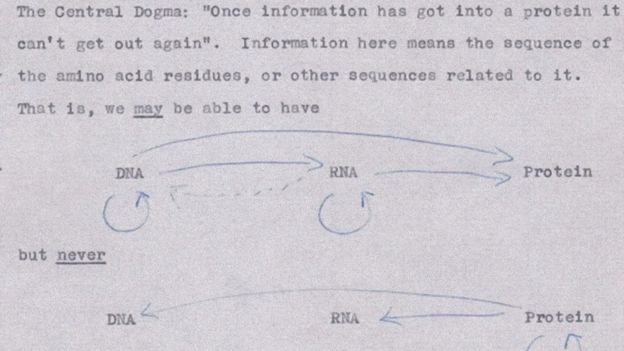
http://www.bbc.com/news/science-environment-41311087 This is an article written to commemorate the lecture given by Francis Crick 60 years ago for the Society for Experimental Biology at University College, London, predicting the way the genetic code is used to produce proteins.How does the cell get from the linear sequence of bases to the three-dimensional structure of proteins. It still amazes me that this was determined based on the scanty knowledge that was available and the relatively primitive technologies (compared with today's.


Crick's 'central dogma' diagram (c) Wellcome Library

http://www.philly.com/philly/health/health-news/penn-scientists-probe-the-mysterious-relationship-between-sleep-deprivation-and-depression-20170922.html An article from the Philly Inquirer about research findings at Penn about sleep deprivation's curative powers over depression. Research has shown that from 3-4 hours of sleep followed by 21 to 36 hours of wakefulness eliminated feelings of depression in 50% of people in 66 studies that were analyzed. This work was published in the Journal of Clinical Psychiatry. The problem was that after one good night's sleep, the depression returned.

https://www.nytimes.com/2017/09/21/business/monsanto-dicamba-weed-killer.html?mcubz=1&_r=0
This is a NYT Business Section article about dicamba, a weed killer marketed by Monsanto. Lawsuits are being initiated against the company because farmers who have not bought Monsanto's genetically modified dicamba-resistant seeds are claiming that their crops are being damaged by dicamba drifting sometimes large distances. This is a typical strategy, to develop these resistant seeds and then to spray weed-killers, both marketed by Monsanto. It seems like a viscous cycle, because as weeds become resistant to the herbicides, it requires more pesticide use to kill them. Drift problems have made it impossible to control where herbicides wind up.


https://www.nytimes.com/2017/09/21/sports/aaron-hernandez-cte-brain.html?mcubz=1 This is a NYT article about the extremely unfortunate case of Aaron Hernandez, former Patriot's linebacker, found guilty of murder, who committed suicide in prison in April. Studies of his brain have revealed CTE, or Chronic Traumatic Encephalopathy. Hernandez was 27 but his the degenerative brain damage was equivalent to the brains of players beyond their 60's. Research has been recently revealed at Boston University showing that players who began playing tackle football before the age of 12 developed more cognitive and behavioral problems as adults later in life than those who started playing after the age of 12.


https://www.nytimes.com/2017/09/09/opinion/sunday/trump-epa-pruitt-science.html?mcubz=0
This is an editorial from NYT about the consistent trend in the current administration to terminate work on important environmental issues such as mountaintop removal of coal and reducing carbon emissions to name only two consequential issues among a multitude. In additional, the lack of appointment of key scientific advisors to various departments and appointment of persons lacking in scientific credentials to key offices shows evident disdain for science and scientific knowledge and its contributions.


https://www.nytimes.com/2017/09/21/nyregion/staten-island-bat-watchers-research.html?mcubz=0&_r=0 This is an article on bat researchers in Freshkills Park on Staten Island. Not surprisingly, these researchers are nocturnal, as are their quarry. Wearing anabat detectors strapped to their wrists, seniors at the College of Staten Island along with wildlife biologists, are netting bats in order to study them. The first published study of bats was in 2016 and the work being compiled is some of the first systematic data collected on bats in NYC. White nose disease, caused by a fungus has decimated the bat population across North America on a massive scale. After netting the bats, the researchers are fitted with tracking bands, weighed and checked for fungus.

iStock_sleep-exhausted-3x2

Friday, September 1, 2017

After Harvey

http://www.medicalnewstoday.com/articles/318713.php?utm_source=TrendMD&utm_medium=cpc&utm_campaign=Medical_News_Today_TrendMD_1
This is from Medical News Today newsletter about research published in the journal Neuron on new treatments for depression, going beyond SSRIs like Prozac and Zoloft. SSRIs prevent serotonin from being reabsorbed at the synapse by the neuron that secreted it after it does its job on the second neuron. Researchers at the Rockefeller University researched the effects of serotonin on cells in the dentate gyrus using a technique called translating ribosome affinity purification and found a receptor important for SSRIs long-term effects.
Brain in a pill.

http://www.npr.org/sections/goatsandsoda/2017/09/02/547892623/triple-threat-new-pneumonia-is-drug-resistant-deadly-and-contagious An npr report about drug-resistant pneumonia (klebsiella pneumoniae) found in a hospital in Hangzhou, China, as reported in the Lancet Infectious Diseases, which was resistant to the toughest antibiotics. Similar strains have been isolated from a case in Nevada, which was resistant to 26 antibiotics but the Chinese stains are deemed "hypervirulent.


https://www.statnews.com/2017/08/29/fat-nutrition-study/ From STAT News, a report of a study called PURE (Prospective Urban Rural Epidemiology recording the eating habits of 135,000 adults in 18 countries. People with the highest intake of dietary fat (35%) were 23% less likely to die during the study period than those whose diet was 10% fat. Findings for carb consumption went in the opposite direction, those whose diet was 77% carb were more likely to die, while those with a 46% carb diet were the least likely. These results were published in the Lancet.


http://www.philly.com/philly/health/health-news/what-diabetic-mice-can-teach-us-about-keeping-teeth-healthy-20170901.html  From the Inquirer a report on a study of dental health done at Penn Dental which looked at the oral microbiomes of people with diabetes. Typically, unmanaged diabetes causes changes to the bacteria in the mouth, leading eventually to inflammation of the gums and bone loss. They compared mouth bacteria from diabetic mice to bacteria from normal mice (former were worse) and then transferred mouth bacteria from diabetic mice to germ free mice and found that diabetic mouth bacteria caused 42% more bone loss than bacteria from normal mice.

https://www.washingtonpost.com/news/answer-sheet/wp/2017/08/28/teacher-shortages-affecting-every-state-as-2017-18-school-year-begins/?utm_term=.f70ec832f89 Article from the WashPost describing US Dept of Education data of states where there are teacher shortages shows that there are teacher shortages in every state.  Shortages have been in existence since data began to be collected 25 years ago but the problem has been exacerbated recently. The teacher education enrollment dropped 35% from 2009 to 2014. There is also an "acute shortage" in substitute teachers.


https://www.nytimes.com/2017/09/06/learning/announcing-a-new-monthly-feature-whats-going-on-in-this-graph.html?mcubz=1 This is an announcement of a new monthly feature in the NYT partnering with the American Statistical Association to produce WGOITGraph? They will offer a NYT graphic and pose questions to students. The graphs will remain online and teachers can use them in the classroom. Students will also be able to post comments.

hs1perio03-29082017-0001