Wednesday, May 6, 2020

Thinking Inside the Box


https://www.lrb.co.uk/the-paper/v42/n09/paul-taylor/susceptible-infectious-recovered
This is an article in the London Review of Books about modeling Covid-19. The first UK strategy, now famously, recommended avoiding the stringent measures that other countries had taken to attempt to mitigate Covid-19. This was based on models developed by the London School of Tropical Medicine and Hygiene and Imperial College, London, no slouches, they.  Changes to government policies happened almost immediately thereafter. These models, according to the article, were both based on data from Wuhan and the variation in the length of time between onset of symptoms and eventual death was estimated from 24 patients and the profile of the length of time it took to recover was estimated from 165 patients. They further calculated that, without doing anything, 85% of the population would be infected, there would be 24 million clinical cases and about 370,000 deaths. When they revised the model by trying to incorporate strategies to mitigate the virus, they estimated that if nothing was done at all 550,000 would die but some of the suggested mitigation strategies (mentionedin the article) would only half that number. It was decided to apply a combination of strategies to suppress the epidemic to bring the R0 (they say R naught) below one. But a problem with this modeling was that the LSHTM modeling brought the cases down to zero, which doesn't happen. It is a good article, worth the read. Models are models.
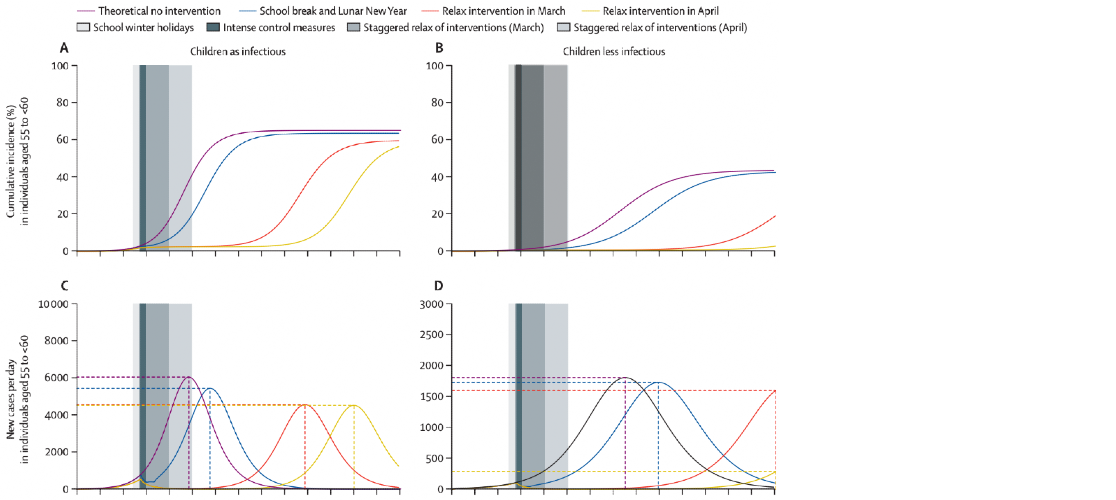
Effect of control strategies (Prem,2020)


https://www.nature.com/articles/d41586-020-01315-7
This is an article from Nature magazine about Covid-19. The coronaviruses were named in 1968 but were discovered in 1912. The SARS outbreak in 2003 showed that these viruses, besides their lethality in animals such as pigs, could also kill people. Coronaviruses are large for viruses that use RNA to replicate and also have a proofreading mechanism which keeps them from making errors in mutating. They can also recombine with other coronaviruses,  a sort of professional courtesy that viruses, and bacteria, do for each other. 7 strains of coronaviruses infect humans, four causing the common cold. The three that cause severe disease are SARS-CoV, MERS and SARS-CoV-2 all come from bats. The known human conronaviruses cause respiratory infections. Cold-causing viruses are satisfied with the upper respiratory tract but the other three move down into the lungs and our current preoccupation, SARS-Co-V2, infects both the URT and the lungs, explaining why people with Covid-19 have such different experiences. How does it get into the lungs? The immune system may be the culprit and the virus may destroy the alveoli, the lung sacs that bring oxygen to the body tissues. The recruitment of white blood cells by the immune system may block airways further, instead of clearing the virus. leaving scarred lungs as lethal souvenirs.
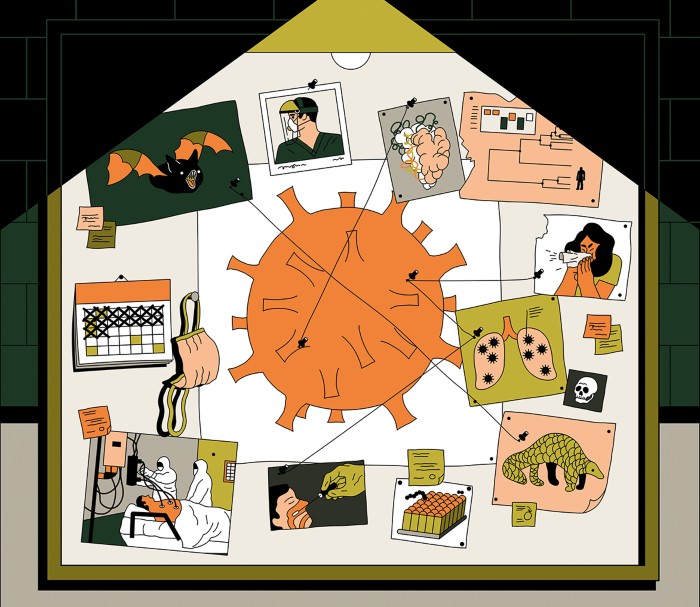

Cartoon showing forensic-like board linking various COVID-19 related images.

https://www.theatlantic.com/health/archive/2020/05/coronavirus-strains-transmissible/611239/
This is an Atlantic article by blogger extraordinaire Ed Yong disputing Los Alamos' claims to have discovered a new, more virulent strain of Sars-Co-V2.  The LA Times went with this non-peer reviewed claim that this was a more transmissible, mutant strain. Viruses always mutate; what they do. Some of the mutations are silent mutations and make no changes, for example to the spike proteins as claimed in this case. Influenza mutates quickly which is why it is hard to guess which strain we will be experiencing the season before it happens.  Sars-Co-V-2 mutates less frequently. D614G is the way the mutant is described and it is a different flavor than the Wuhan virus and the major virus being isolated in Europe, North America and Australia.  This one could have outcompeted the Wuhan virus or it could be, as Yong reports, "dumb luck".  There have not been head-to-head studies of both viruses under controlled circumstances. The 5 virologists consulted for this article all agree that there is "just one strain" of Sars-Co-V-2.


https://science.sciencemag.org/content/368/6488/214
This is a science magazine article about the inequalities in advising people to "social distance", which is not possible in poor nations, urban slums, refugee camps or in populations that cannot afford the luxury of working from home. Pope Francis called this "the moment to see the poor."  The digital divide between rich and poor means that access to important health information, (testing sites, dates and availability, for example, purchasing information for PPE) may not be received in low income communities, with dire consequences. The article makes the important point that with the dissolution of some of the fragile international economic links which enable cross-border flows of goods, services, money, ideas, and people, there is additional suffering in poor areas, which may take time too be repaired.


https://jamanetwork.com/journals/jamainternalmedicine/fullarticle/2763720
This is an article from JAMA that explores the association between healthy lifestyle factors and the number of years lived without the development of chronic diseases (diabetes, coronary heart disease, cancer, asthma and COPD). Using 4 factors for baseline: smoking, body mass index, physical activity and alcohol consumption and a scoring system of risk status using 2 = optimal, 1= intermediate, 0 = poor, they developed an aggregate lifestyle score from 0 (worst) to 8 (best). All of the 4 lifestyle profiles associated with the highest number of disease-free years included a BMI of less than 25, and at least  two of the following factors: never smoking, physical activity, and moderate alcohol consumption.


https://www.nytimes.com/interactive/2020/climate/trump-environment-rollbacks.html

This is an article from NYT about environmental policy rollbacks including reductions in carbon-dioxide emissions associated with planet warming, and rules governing clean air, water and toxic chemicals in the environment. This NYT analysis was based on research from the Harvard and Columbia law schools. The Interior Department has also opened up federal lands for oil and gas leasing and rolled back wildlife protection legislation. Rather than returning the EPA to its core mission, as Trump promised to do, his administration has even limited its own power to regulate environmental harm.


https://www.nytimes.com/2020/05/07/business/school-education-online-money.htm

This is an article from the education section about the vast inequalities embodied in the necessity of the schools to move online. What is going to happen in the Fall? Even with the optimistic assumption that we will be able to move back into our physical structures allowing for social distancing, there may be rolling closures. Transitioning to online requires technical and pedagogical support for schools and teachers. Even if this can be provided, there is the possibility, maybe the probability that about 1/3 of the school year will have been sacrificed to the pandemic, according to the article. Assuming that a year of public education costs $400 billion, $133 billion may be needed to make up for the lst instruction.  The author concludes that a "privileged minority" of children may be well-educated, using private tutors and home schooling but the majority, dependent on public education, will be left behind.


Monday, May 4, 2020

Thoughts From Inside

https://www.nytimes.com/2020/05/03/world/europe/coronavirus-antibodies-italy.html
This NYT article describes the "antibody passport", meaning that if it is determined by a blood test that one has mounted an IgG antibody response to the Sars-CoV-2, one may go about one's daily business. This might require, I imagine, a sort of antibody police and the possession of an antibody license, without which one would be returned to sequestration, upon threat of a more severe penalty  than sequestration. The sticking point here is that people develop different quantities of antibodies, which may last different amounts of time and may or may not be protective. So, it is complicated. The article says that an IgG antibody would neutralize the virus, but in my experience, the mere existence of an IgG subclass doesn't mean that the antibody is neutralizing, which means that it inactivates the virus.  Levels of complexity.


https://www.nytimes.com/2020/05/03/opinion/dave-eggers-coronavirus-questions.html
This is a NYT article by Dave Eggers about the actual versus the public space perception of our risk of  contracting the coronavirus (Covid-19), the disease caused by Sars-CoV-2. Is it dangerous or "low risk"?  If we stay inside, will it go away? Is it less potent in the summer? The virology, immunology and vaccinology qualifications of the deliverers of the erratic and contradictory media messages are questionable. And the history of the 1918-1919, which infected 500 million people is a potent reference in the literature, if not public memory.


https://www.nytimes.com/2020/05/04/climate/heat-temperatures-climate-change.html
Moving away from Covid-19 for a millisecond,  this NYT article reminds us that, with the rise in global population expected to rise by 10 million by 2070, as many as 3.5 billion people will live in conditions considered unsuitable for human habitation. These numbers are admittedly the "worst case scenario",  according to climate scientists but there are a lot of worst case scenarios that are playing out now in our current environment. According to the article, history shows that the vast majority of people has always been concentrated in a narrow temperature range.


https://www.nytimes.com/2020/05/04/health/gene-therapy-harvard-coronavirus.html
Back to the main topic of interest: Covid-19.  This NYT article describes work at Mass Eye and Ear and another hospital which use an AAV or adeno-associated virus to deliver DNA in a vaccine. This AAV is a harmless virus that has been approved and is safe. Using this technique requires miniscule amounts of material, so the yield would be high in manufacturing the vaccine. What happens is that,the virus, also known as a vector, gets the coronavirus' DNA into cells, which is transcribed and translated (jargon-y words) in the cell to eventually crank out a protein to put the immune system on alert.

 https://science.sciencemag.org/content/368/6490/476
This is a super-great AAAS policy-forum observation of a pivoting in practices and a caution against compromising the rigorous standards of scientific research in a time of crisis, as we are living through now. Examples are not conducting randomized controlled clinical trials. Are "fastidious research standards" a luxury in a pandemic, when death is knocking? Should "sub-optimal" study design be acceptable?  Are small sample sizes and lack of blinding in an age of urgency practices that will accomplish the desired end: a treatment and a vaccine? The article makes the point that "the challenges that rigorous methods address don't disappear in the face of urgent need."

Embedded Image

https://www.youtube.com/watch?v=XlnUt9vK3-Q&feature=youtu.be
This is a great youtube video from Penn done by a researcher who has worked on coronaviruses for 30 years. It is part of a symposium.
faculty photo

https://www.nytimes.com/2020/05/05/health/crispr-coronavirus-covid-test.html
This article is about how to use the Crispr/Cas9 system to report on the presence of the virus in a sample. Is is called SHERLOCK and works a little like the pregnancy test in that thepositive results develop on a paper and can be read as a y/n. It was developed at the MIT McGovern Institute and there are similar tests being developed at the U of Buenos Aires and CASPR Biotech in San Fransisco. The components would be cheaper than the pcr-based test, which also involves more steps. This new test is in a preprint and it has also to be determined whether it is scalable.

Saturday, August 11, 2018

Saturday, Looking Like Sunday

https://www.nytimes.com/2018/08/08/upshot/chores-girls-research-social-science.html  This is from The Upshot, which was based on American Time Use Survey diaries from 2003 to 2014 by 6,358 high school students ages 15-19. Maybe this is even too late (this writer's opinion). Boys ages 15-19 do about half and hour of housework and girls about 45 minutes. According to the article, girls' chores take a little less time than a decade ago, but boys' allocation hasn't changed. This also varied with parents' education but the difference was mostly seen in girls. Boys were also paid more allowance for their time, based on an APP called BusyKid, twice what girls earned. The gender gap in pay for chores and time spent was worldwide. In terms of caring for other family members, boys ans girls spend the same amount of time; researchers expect that this could result in these boys becoming more engaged fathers.


https://www.nytimes.com/2018/08/07/opinion/stem-girls-math-practice.html
A commentary from the NYT about STEM and girls and the importance of math skills. Not practicing math, even if you are good at it, can turn into a lack of competence, according to several research studies. Becoming an expert at anything, according to K. Anders Ericsson, requires developing neural patterns and honing them (my addition here) through practice and repetition. The commentary critiques modern methods that attempt to "make learning more fun" by avoiding drill and practice. In the international PISA study  the US ranks near the bottom of the 35 industrialized nations in math and that's not just girls. All learning shouldn't be "fun" (a quote).  I agree but it is hard to convince the students that there is something in it for them when the screens stop flashing and the equations appear.


https://njenvironmentnews.com/2018/07/23/n-j-finds-pfnas-chemicals-of-emerging-concern-in-some-recreational-fishing-waters/ This is an article from the NJ Environment News about PFAs, including PFOA, PFOS and PFNA, compounds that were used to make non-stick cookware, in NJ recreational waters.  Exposure to PFAs can lead to adverse health effects in humans, including high cholesterol.
The report was by theAgency for Toxic Substances and Disease Registry (ATSDR). The DEP sampled water, fish tissue and sediment.  The DEP cautioned anglers to eat very limited amounts of certain species found in waters where PFAS was detected.
new jersey environment, delaware river

Sunday, July 22, 2018

Birthday Blog

http://journals.plos.org/plosone/article?id=10.1371/journal.pone.0200103 This is a PLOS ONE research article in which researchers weighted data from two independent surveys with census data to come up with the conclusion that 65% of Americans think that they are "above average" in intelligence. There have been problems with the generalizability of data collections in surveys showing the :greater than average" effect. Intelligence is normally distributed throughout the population and not skewed like other desirable traits. Researchers used a bunch of different types of surveys (telephone, online) weighted to the US census (2010). 65% agreed wih statement "I am more intelligent than the average person" as a conservative estimate. The survey concluded that college graduates slightly underestimated their relative intelligence whereas undereducated  people overestimated thier relative intelligence.


thumbnail

 https://www.statnews.com/2018/07/20/fda-approves-agios-first-in-class-leukemia-treatment/
This is an article from STAT news about a first-in-class leukemia drug approved by the FDA. It treats refractory AML sufferers from whhich possess a mutation in the gene IDH1. The drug received "orphan drug" status and the price for a monthly supply is about  $26,000. 30% of people in clinical trails saw their disease go into complete remission.


https://www.nytimes.com/2018/07/23/well/chemicals-food-children-health.html An article from NYT reporting on an AAP issuance of new guidelines for exposure of young children to plastics in food containers, exposure of pregnant women to processed meats and consumption of fresh foods and vegetables over processed food. This revision of guidelines has been influence by other professional groups in response to scientific evidence pointing to exposure to certain chemicals in foods as a culprit in interfering with development. Nitrates and nitrites in meat products, phthalates in plastics and bisphenols in metal cans have been identified as well as PFCs used in grease-proof  paper and perchlorates, used in plastic packaging.  Wrap foods in wax paper instead of plastic wrap and avoid canned and processed food is a take-home from the article. Some of these chemicals interfere with or block hormone function.


https://www.nytimes.com/2018/07/23/science/genes-education.html An article in NYT about a study reported in Nature Genetics on how genes affect how people do in school. The study found that many of the genetic variants implicated in educational attainment are involved in how neurons communicate in the brain. Genetic sequencing was done on over 1 million people, mostly white and of European descent. One of the study's finding were that certain genetic variants were found among found in people who finished school compared with those who left school early and those variants were involved with helping neurons form connections in the brain. The researchers figured out how to calculated a "genetic score" for educational success.


https://www.nytimes.com/2018/07/23/opinion/spider-in-my-life.html This is an opinion of sorts by Margaret Renkl in the NYT about the spider in her family room. When your "world has lost its center" the spider provides a source of stability. Surprise; we are talking about politics. Ms. Renkl takes comfort in one small spider in a well-written piece reminiscent of many writers using nature metaphorically.


https://www.nytimes.com/2018/07/25/style/sperm-count.html This is an article in the STYLE section of the NYT about the declining numbers of sperm in American males. A metaanalysis of 185 st. udies last summer concluded that sperm numbers have declined in a generation. Are men being feminized? Does lifestyle matter? Is there birth control in the water supply? A fertility start up company sells a sperm activity test because, in terms of fertilization, the sperm's ability to move is critical. There is also an app to watch your sperm move under a microscope live streamed on your phone. (I guess that's why it is in the style section.) Call this article "Semen Variations".


https://www.nytimes.com/2018/07/19/climate/endangered-species-act-changes.html Article from the NYT about the proposed changes to the Endangered Species Act. The 1973 law had seen few changes in 30 years. The deputy Secretary of the Interior claims that the changes to the law will streamline it, improving the regulatory process and providing more protection thereby. Environmental activists protest that the changes will set more species on the path to extinction. The Trump administration is also set to roll back the National Environmental Policy Act which lays out the policy that federal agencies must follow when planing infrastructure projects.


http://www.philly.com/philly/health/depression-treatment-blood-test-acetyl-l-carnatine-20180731.html Article in the inquirer about a new biomarker for depression which may be used in drug development to come up with a new mechanism. The biomarker is acetyl-L-carnitine, which is a product of cellular metabolism. Allegedly, things like childhood neglect contribute to the level of acetyl-L-carnitine and the publication indicates a correlation between the biomarker and severity of depression. I will need to be convinced of this before believing it.
http://media.philly.com/images/1200*800/dixon-635518-f-wp-content-uploads-2018-07-he1depress01-e1533038415875-1200x801.jpg

https://www.sciencealert.com/having-children-makes-women-s-dna-cells-age-equivalent-11-years-telomeres  From Science Alert a report of a study in Human Reproduction about a sampling of DNA from nearly 2000 reproductive aged women which showed that that women who had given birth to at least one child had telomeres that were 4.2 percent shorter on average than those of women who had not borne children.e who had given birth had altered telomeres, a mark of cellular aging. It could mean that giving birth to one child is equivalent to 4.5 years of cellular aging.
main article image
Vintage filtered on silhouette of depressed girl sitting on the window

Sunday, July 1, 2018

99 degrees and counting

http://www.philly.com/philly/health/fear-of-math-is-harmful-to-your-health-this-woman-wants-to-help-20180629.html  An article from the Philadelphia Inquirer from a scholar at the Annenberg Public Policy Center at the University of Pennsylvania who is writing a book about the effects of innumeracy. Quoted from the article, "According to data reported in 2013, almost a third of the U.S. adult population can do only simple operations with numbers — they can count, sort, and do simple arithmetic. If you translate that into the current U.S. adult population, there are about 73 million people who can do up to only basic problems with numbers."  That means they also understand less in terms of how to take a missed dose of medicine (it says to do so on some medications), and also tends to mean that they rely on anecdotal information, which could have no bearing on their own circumstances. People who have diabetes also have to modify their insulin dosages based on their glucose levels and innumeracy make it complex. They also must read meters and other devices. Many people don't know what relative risk is compared to absolute risk and not understand that doubling one's risk could mean 20% to 40% or mean 0.01% to 0.02%, which is negligible.

https://www.nytimes.com/2018/07/13/science/youtube-science-women.html An article from the NYT about  comments left on youtube videos made by women. In a paper published in the JOurnal for the Public Understanding of Science women depicted drew more comments per view than men and more critical comments on their appearance. Some of the researchers' findings echoed a 2014 TED talks study in which it was reported that "when the presenter was a woman, 15.28 percent of comments were about her as opposed to the talk, when the speaker was a man, only 9.84 percent of comments were about him." This is having a discouraging effect on women who wish to make videos on a professional of semiprofessional level, according to the article and study.


http://www.philly.com/philly/health/depression-medication-genetic-test-genomind-anxiety-adhd-20171026.html This is an article in the Philadelphia Inquirer about a new genetic test for resistance to depression medications. It is called the Genomid Genecept  Assay test. It is better at predicting whether a medication will not work. It uses a proprietary algorithm to analyse 12 different genes to weight their combined effects on patient response to more than 55 different medications.  Some pharmacists will be trained to counsel patients if they see a pattern of unresponsiveness to treatments. There is a type of treatment called TMS (transcranial magnetic stimulation) or else electrocution therapy (ECT) is used typically used for patients unresponsive to medication.
Photos – local – genomind29-h

Saturday, June 2, 2018

Junesomething

https://www.nytimes.com/2018/05/30/well/cancer-group-calls-for-colorectal-cancer-screening-starting-at-age-45.html An article from the NYT about the new guidelines from the American Cancer Society recommending that people age 45 and above receive colorectal cancer screening. There will be six options offered for screening, including stool sample collection at home to be brought to a lab for tests, to colonoscopy, the most invasive test. This screening is necessary because it is expected that 16.450 new cases of colon cancer will be diagnosed in the age group 45-49 Americans under the age of 50 this year. There has been a 50% increase in cases of colon cancer in adults under the  age of 50 from 1994 to 2014. I have had students (college) who have had more than one colonoscopy so I am only partly surprised by this.


https://www.theguardian.com/lifeandstyle/2018/jun/06/broccoli-coffee-scientists-create-new-way-to-eat-more-greens  From The Guardian, Scientists have made powdered broccoli, which can be added to foods to increase the amount of greens in one's diet.  This was done by the Australian science agency CSIRO. But I don't think of broccoli as "ugly" produce.


https://www.nytimes.com/2018/06/09/opinion/protected-area-myth.html This is an opinion in the NYT about areas devoted to wildlife protection according to the 1993 Convention on Biological Diversity. The author asks us to examine what he calls the "delusions" that accompany this type of project. Apparently, designating these areas is easy but protecting them hard. In Australia's Barrow Island Marine Park, a designated protected area due to the richness of wildlife there, the government allowed construction of a vast energy complex. There is something called Paddd, protected area downgrading, downsizing and degazettement (?) because this is such a common occurrence.


https://www.nytimes.com/2018/06/09/climate/trump-administration-science.html An article from NYT about the fact that, even now as Trump meets with North Korea, when denuclearization is sure to come up as a topic of conversation, Trump has no science advisor. Past advisors to presidents  say that the absence of such high level expertise could put Mr. Trump at a disadvantage. (I would have said "is sure to"). This indicates the marginalization of science is shaping US policy. Neither the State Department nor the Department of Agriculture have chief scientists, for example. Even as we speak, Scott Pruitt, head of the EPA, is rolling back legislation designed to protect the environment.


https://www.nytimes.com/2018/06/13/health/mediterranean-diet-heart-disease.html An article in NYT about the Mediterranean Diet Study, much-cited, reporting that the Mediterranean diet, containing more vegetables and fruits, cuts risk of heart attacks/strokes, was not randomized. The paper was reanalyzed and, according to Barnett Kramer, director of cancer prevention studies at NCI. contains the same flaws.


https://www.nytimes.com/2018/06/13/climate/antarctica-ice-melting-faster.html This goes into the Antarctica is Melting column. 0.3 inch doesn't sound like a lot for the sea level to rise but this is the statistic for the years 2112-2117 as published in the journal Nature. By 2100 it is expected that there will be a rise of another 6 inches as estimated by the  Intergovernmental Panel on Climate Change. Oh, not to mention that Greenland also lost one trillion tons of ice between 2011 and 2014.