https://www.lrb.co.uk/the-paper/v42/n09/paul-taylor/susceptible-infectious-recovered
This is an article in the London Review of Books about modeling Covid-19. The first UK strategy, now famously, recommended avoiding the stringent measures that other countries had taken to attempt to mitigate Covid-19. This was based on models developed by the London School of Tropical Medicine and Hygiene and Imperial College, London, no slouches, they. Changes to government policies happened almost immediately thereafter. These models, according to the article, were both based on data from Wuhan and the variation in the length of time between onset of symptoms and eventual death was estimated from 24 patients and the profile of the length of time it took to recover was estimated from 165 patients. They further calculated that, without doing anything, 85% of the population would be infected, there would be 24 million clinical cases and about 370,000 deaths. When they revised the model by trying to incorporate strategies to mitigate the virus, they estimated that if nothing was done at all 550,000 would die but some of the suggested mitigation strategies (mentionedin the article) would only half that number. It was decided to apply a combination of strategies to suppress the epidemic to bring the R0 (they say R naught) below one. But a problem with this modeling was that the LSHTM modeling brought the cases down to zero, which doesn't happen. It is a good article, worth the read. Models are models.
This is an article in the London Review of Books about modeling Covid-19. The first UK strategy, now famously, recommended avoiding the stringent measures that other countries had taken to attempt to mitigate Covid-19. This was based on models developed by the London School of Tropical Medicine and Hygiene and Imperial College, London, no slouches, they. Changes to government policies happened almost immediately thereafter. These models, according to the article, were both based on data from Wuhan and the variation in the length of time between onset of symptoms and eventual death was estimated from 24 patients and the profile of the length of time it took to recover was estimated from 165 patients. They further calculated that, without doing anything, 85% of the population would be infected, there would be 24 million clinical cases and about 370,000 deaths. When they revised the model by trying to incorporate strategies to mitigate the virus, they estimated that if nothing was done at all 550,000 would die but some of the suggested mitigation strategies (mentionedin the article) would only half that number. It was decided to apply a combination of strategies to suppress the epidemic to bring the R0 (they say R naught) below one. But a problem with this modeling was that the LSHTM modeling brought the cases down to zero, which doesn't happen. It is a good article, worth the read. Models are models.
https://www.nature.com/articles/d41586-020-01315-7
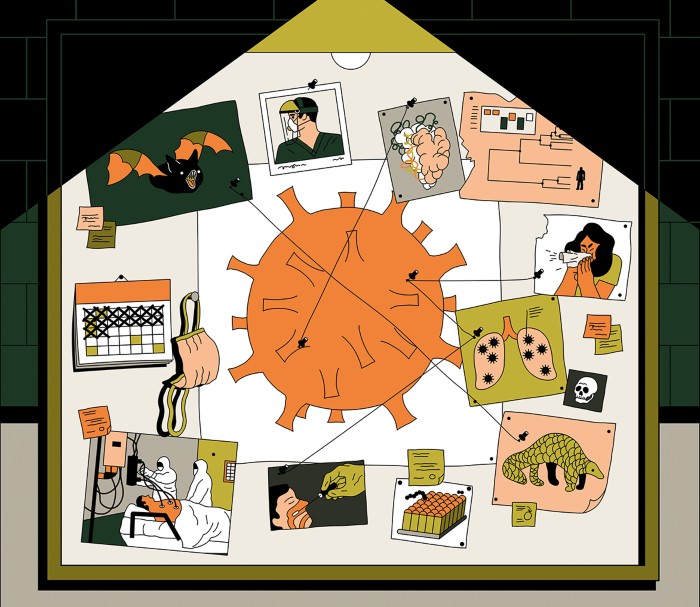
This is an article from Nature magazine about Covid-19. The coronaviruses were named in 1968 but were discovered in 1912. The SARS outbreak in 2003 showed that these viruses, besides their lethality in animals such as pigs, could also kill people. Coronaviruses are large for viruses that use RNA to replicate and also have a proofreading mechanism which keeps them from making errors in mutating. They can also recombine with other coronaviruses, a sort of professional courtesy that viruses, and bacteria, do for each other. 7 strains of coronaviruses infect humans, four causing the common cold. The three that cause severe disease are SARS-CoV, MERS and SARS-CoV-2 all come from bats. The known human conronaviruses cause respiratory infections. Cold-causing viruses are satisfied with the upper respiratory tract but the other three move down into the lungs and our current preoccupation, SARS-Co-V2, infects both the URT and the lungs, explaining why people with Covid-19 have such different experiences. How does it get into the lungs? The immune system may be the culprit and the virus may destroy the alveoli, the lung sacs that bring oxygen to the body tissues. The recruitment of white blood cells by the immune system may block airways further, instead of clearing the virus. leaving scarred lungs as lethal souvenirs.
https://www.theatlantic.com/health/archive/2020/05/coronavirus-strains-transmissible/611239/
This is an Atlantic article by blogger extraordinaire Ed Yong disputing Los Alamos' claims to have discovered a new, more virulent strain of Sars-Co-V2. The LA Times went with this non-peer reviewed claim that this was a more transmissible, mutant strain. Viruses always mutate; what they do. Some of the mutations are silent mutations and make no changes, for example to the spike proteins as claimed in this case. Influenza mutates quickly which is why it is hard to guess which strain we will be experiencing the season before it happens. Sars-Co-V-2 mutates less frequently. D614G is the way the mutant is described and it is a different flavor than the Wuhan virus and the major virus being isolated in Europe, North America and Australia. This one could have outcompeted the Wuhan virus or it could be, as Yong reports, "dumb luck". There have not been head-to-head studies of both viruses under controlled circumstances. The 5 virologists consulted for this article all agree that there is "just one strain" of Sars-Co-V-2.
https://science.sciencemag.org/content/368/6488/214
This is a science magazine article about the inequalities in advising people to "social distance", which is not possible in poor nations, urban slums, refugee camps or in populations that cannot afford the luxury of working from home. Pope Francis called this "the moment to see the poor." The digital divide between rich and poor means that access to important health information, (testing sites, dates and availability, for example, purchasing information for PPE) may not be received in low income communities, with dire consequences. The article makes the important point that with the dissolution of some of the fragile international economic links which enable cross-border flows of goods, services, money, ideas, and people, there is additional suffering in poor areas, which may take time too be repaired.
https://jamanetwork.com/journals/jamainternalmedicine/fullarticle/2763720
This is an article from JAMA that explores the association between healthy lifestyle factors and the number of years lived without the development of chronic diseases (diabetes, coronary heart disease, cancer, asthma and COPD). Using 4 factors for baseline: smoking, body mass index, physical activity and alcohol consumption and a scoring system of risk status using 2 = optimal, 1= intermediate, 0 = poor, they developed an aggregate lifestyle score from 0 (worst) to 8 (best). All of the 4 lifestyle profiles associated with the highest number of disease-free years included a BMI of less than 25, and at least two of the following factors: never smoking, physical activity, and moderate alcohol consumption.

This is an article from NYT about environmental policy rollbacks including reductions in carbon-dioxide emissions associated with planet warming, and rules governing clean air, water and toxic chemicals in the environment. This NYT analysis was based on research from the Harvard and Columbia law schools. The Interior Department has also opened up federal lands for oil and gas leasing and rolled back wildlife protection legislation. Rather than returning the EPA to its core mission, as Trump promised to do, his administration has even limited its own power to regulate environmental harm.

https://www.nytimes.com/2020/05/07/business/school-education-online-money.htm
This is an article from the education section about the vast inequalities embodied in the necessity of the schools to move online. What is going to happen in the Fall? Even with the optimistic assumption that we will be able to move back into our physical structures allowing for social distancing, there may be rolling closures. Transitioning to online requires technical and pedagogical support for schools and teachers. Even if this can be provided, there is the possibility, maybe the probability that about 1/3 of the school year will have been sacrificed to the pandemic, according to the article. Assuming that a year of public education costs $400 billion, $133 billion may be needed to make up for the lst instruction. The author concludes that a "privileged minority" of children may be well-educated, using private tutors and home schooling but the majority, dependent on public education, will be left behind.


